
Mitosis vs meiosis describes two different ways cells divide.
Both move chromosomes, but their biological goals differ sharply.
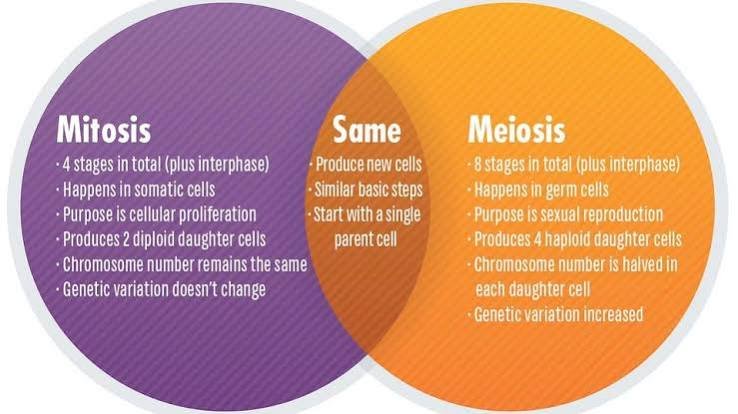
Mitosis vs Meiosis at a Glance
| Feature | Mitosis | Meiosis |
|---|---|---|
| Main purpose | Growth, repair, cell replacement | Production of haploid reproductive cells |
| Number of divisions | One | Two |
| Typical final products | Two daughter cells | Four haploid cells |
| Chromosome sets | Usually maintained | Reduced by half |
| Genetic similarity | Usually genetically identical | Genetically different |
| Homologous pairing | No | Yes, during meiosis I |
| Crossing over | Not part of normal mitosis | Occurs during prophase I |
| DNA replication | Once before division | Once before meiosis I |
| Human chromosome example | 46 → 46 per daughter cell | 46 → 23 per final cell |
The National Human Genome Research Institute defines mitosis as chromosome segregation producing two identical nuclei. It defines meiosis as division that reduces chromosome number in gametes.
What Is the Main Difference Between Mitosis and Meiosis?
The clearest difference is not the stage names.
It is what happens to chromosome sets.
Mitosis generally preserves the chromosome-set number. A diploid human cell can therefore produce diploid daughter cells. Meiosis starts with a diploid cell but creates haploid products. This reduction is necessary for sexual reproduction.
Humans normally have 46 chromosomes in somatic cells. These form 23 chromosome pairs. Human gametes carry one chromosome set instead. This allows fertilization to restore the diploid chromosome number.
How Mitosis Works
Mitosis is closely linked with growth and tissue maintenance. Before mitosis begins, DNA has already been replicated. Each duplicated chromosome contains sister chromatids that must be distributed accurately.
During mitosis, chromosomes condense and become organized. They align before sister chromatids separate. The separated chromosome copies move toward opposite sides. Nuclear division is commonly followed by cytokinesis.
The result is normally two daughter cells. Their nuclei contain chromosome information matching the original nucleus. Importantly, mitosis does not normally halve the chromosome-set number.
How Meiosis Works
Meiosis is different because it includes two nuclear divisions. However, DNA is replicated only once before those divisions begin. This detail explains much of the process.
Meiosis I Separates Homologous Chromosomes
During meiosis I, homologous chromosomes pair. These are corresponding chromosomes inherited from different parents. Their pairing creates opportunities for genetic recombination.
Homologous chromosome pairs then separate into different cells. This first division reduces the number of chromosome sets. For that reason, meiosis I is often called a reduction division.
Meiosis II Separates Sister Chromatids
DNA does not replicate again before meiosis II. Instead, the sister chromatids are separated. In that respect, meiosis II resembles mitosis more closely than meiosis I does.
After both divisions, one diploid starting cell commonly produces four haploid nuclei. These products are genetically different from one another.
Mitosis vs Meiosis: The Process Compared
| Process Point | Mitosis | Meiosis |
|---|---|---|
| DNA copied first? | Yes | Yes |
| First major separation | Sister chromatids | Homologous chromosomes |
| Second division | None | Sister chromatids separate |
| Homologous chromosomes pair? | No | Yes |
| Recombination normally occurs? | No | Yes |
| Chromosome-set reduction | No | Yes |
| Genetic diversity created | Limited | Strongly increased |
This comparison reveals an often-overlooked point. Meiosis II can look similar to mitosis, but their starting conditions differ. By meiosis II, homologous chromosome pairs have already separated.
Why Meiosis Produces Genetic Variation
Meiosis does more than reduce chromosome numbers. It also reshuffles inherited genetic material.
One mechanism is independent assortment. Maternal and paternal homologous chromosomes can enter gametes in different combinations. With 23 chromosome pairs, independent assortment alone can theoretically generate more than eight million chromosome combinations before crossing over is considered.
The second major mechanism is crossing over. Homologous chromosomes exchange DNA between nonsister chromatids during prophase I. This recombination creates chromosomes containing new combinations of inherited DNA.
That makes meiosis central to genetic diversity. Mitosis has a different priority. Its normal function depends on reliable chromosome copying and distribution rather than deliberate genetic reshuffling.
A Better Way to Understand Chromosome Numbers
A common mistake is counting chromatids as separate chromosome sets. The easier approach is to track homologous sets first.
Before division, DNA replication doubles the amount of DNA. It does not automatically change a diploid cell into a tetraploid cell. Each replicated chromosome simply contains two sister chromatids.
Meiosis I changes ploidy because homologous chromosome pairs separate. Meiosis II then separates sister chromatids without another DNA-replication round. This sequence explains how meiosis converts diploid starting cells into haploid products.
Why Both Types of Cell Division Matter
Mitosis allows organisms to increase cell numbers while maintaining genetic continuity. It is fundamental to growth, cell replacement, and many forms of asexual cell reproduction.
Meiosis solves a different biological problem. Sexual reproduction combines genetic material from two gametes. Those gametes must contain reduced chromosome sets, or chromosome numbers would double after each generation.
In humans, the relationship is easy to see. Most somatic cells contain 46 chromosomes. Normal egg and sperm cells contain a haploid set of 23. Fertilization brings two haploid sets together again.
Similarities Between Mitosis and Meiosis
Mitosis and meiosis are not completely separate mechanisms. Both involve chromosome condensation, spindle-based chromosome movement, alignment, and segregation. Both also depend on DNA replication occurring before the relevant division sequence begins.
Their shared terminology reflects these similarities. Both processes use stages such as prophase, metaphase, anaphase, and telophase. Meiosis simply runs through two division sequences, labeled meiosis I and meiosis II.
Common Mitosis vs Meiosis Mistakes
- “Meiosis copies DNA twice.” It does not. DNA replicates once before meiosis I.
- “Mitosis always creates haploid cells.” Mitosis generally preserves the starting ploidy level.
- “Meiosis I separates sister chromatids first.” It primarily separates homologous chromosomes.
- “Meiosis produces identical cells.” Recombination and assortment create genetic differences.
- “Both divisions mainly serve growth.” Meiosis primarily supports sexual reproduction.
Mitosis vs Meiosis: Final Takeaway
The fastest way to remember mitosis vs meiosis is through outcomes.
Mitosis preserves. Meiosis reduces and reshuffles.
Mitosis normally produces two genetically similar daughter nuclei while preserving chromosome sets. Meiosis uses two divisions to generate haploid products and increase genetic variation. Those differences explain why one process supports cellular continuity while the other supports sexual reproduction.
Authoritative Sources
| Source | What It Supports |
|---|---|
| National Human Genome Research Institute | Official definitions of mitosis and meiosis NHGRI — Mitosis |
| National Human Genome Research Institute | Meiosis and chromosome reduction NHGRI — Meiosis |
| OpenStax Biology | Detailed meiosis stages and comparison OpenStax — The Process of Meiosis |
| NCBI Bookshelf | Crossing over and independent assortment NCBI — Meiosis |