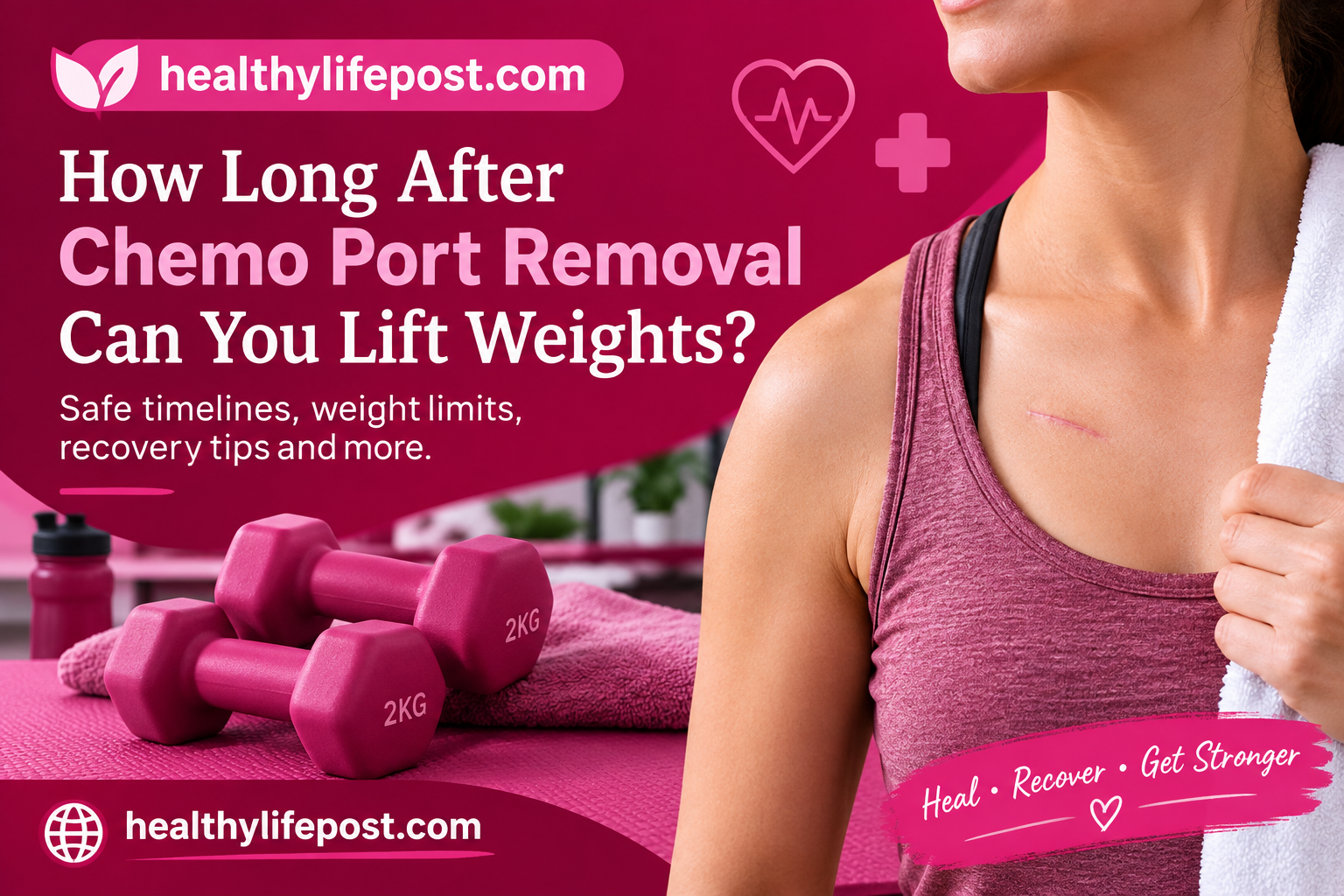

If you recently had a chemo port removed, weightlifting needs patience.
The incision needs time to heal before heavy upper-body exercise.
Most guidance recommends avoiding heavy lifting for several days to one week.
Your surgeon’s instructions should always take priority.
Quick Answer: When Can You Lift Weights?
For many people, light activity can resume fairly quickly. However, heavy weightlifting usually needs a short recovery period.
After implanted port removal, Alberta Health Services advises avoiding weights above 10 pounds (4.5 kg) for one week. It also recommends avoiding vigorous arm movements during that period.
Memorial Sloan Kettering gives slightly different guidance. Its instructions say not to lift more than 10 pounds for three days after removal. This difference shows why individual medical instructions matter.
At a Glance
| Question | General Guidance |
|---|---|
| Light daily activity | Often possible soon |
| Heavy lifting | Usually avoid temporarily |
| 10+ pound weights | Commonly restricted initially |
| Upper-body workouts | Wait until the incision heals |
| Full gym training | Gradual return is safer |
| Best clearance | Your treating clinician |
These are general guidelines, not personal medical clearance.
Why Weightlifting Needs a Waiting Period
Port removal involves a small surgical incision. The port and catheter are removed through that opening. The skin is then closed with sutures, adhesive strips, or similar methods.
Weightlifting can strongly engage the chest, shoulder, and arm muscles. Those movements can pull on the healing incision. Heavy lifting may also increase discomfort or bleeding around the wound.
Johns Hopkins notes that activity restrictions can include avoiding weights above 10 pounds. Exercise may also be restricted temporarily after port removal.
A Practical Recovery Timeline
There is no single schedule for everyone. Recovery depends on the procedure and wound condition.
First 24 Hours
Rest and protect the removal site. Follow your discharge instructions closely.
Johns Hopkins recommends keeping the dressing dry initially. It also advises following your clinician’s wound-care instructions.
Avoid gym workouts during this early period. Normal gentle movement may be acceptable if your clinician allows it.
Days 2 to 3
Some patients can return to ordinary activities. However, heavy lifting may remain restricted.
Memorial Sloan Kettering recommends avoiding lifting above 10 pounds for three days.
Pain, swelling, or tenderness should guide your activity level. Do not push through worsening symptoms.
Days 4 to 7
This is often the point when restrictions begin easing.
Alberta Health Services recommends avoiding weights above 10 pounds for the first week. It also advises avoiding vigorous arm movements during that period.
If the incision looks healthy, light exercise may become reasonable. Your medical team should confirm heavier training.
After One Week
Some people can gradually return to weight training after one week.
NYU Langone advises avoiding strenuous activity, including heavy lifting, for one week. It also notes that upper-arm movements may remain uncomfortable for one or two weeks.
A gradual return is better than immediately lifting your previous maximum.
How Should You Return to Weightlifting?
Start below your normal training level. Your first workout should not test your strength.
Consider this gradual approach:
- Begin with walking or gentle lower-body movement.
- Use very light weights initially.
- Avoid exercises causing chest discomfort.
- Avoid aggressive stretching around the incision.
- Increase weight gradually.
- Stop if pain develops around the wound.
This approach reduces unnecessary strain while the incision continues healing.
Upper-Body Exercises Need Extra Caution
Bench presses, overhead presses, rows, and pull-ups involve the upper body heavily. These exercises can stretch tissues around the chest and shoulder.
That does not mean they are permanently unsafe. It means timing matters during early recovery.
Alberta Health Services specifically recommends avoiding arm movements that pull on the incision during the first week.
What If the Incision Still Hurts?
Pain is an important reason to delay heavier exercise.
Mild discomfort can occur after port removal. Bruising, swelling, and tenderness can also happen during recovery.
Do not increase training simply because a specific number of days has passed. Your wound may heal faster or slower than another person’s.
Contact your healthcare team if symptoms are worsening.
Warning Signs That Need Medical Attention
Seek medical advice if you notice:
- Increasing redness around the incision
- Significant swelling
- Persistent or worsening pain
- Bleeding that does not stop
- Fluid or pus from the wound
- Fever of 100.4°F (38°C) or higher
- New swelling of the arm
- Shortness of breath or chest pain
Johns Hopkins lists fever, redness, swelling, bleeding, and discharge among reasons to contact a healthcare professional.
Chest pain or serious breathing problems require urgent medical attention.
Does Chemo Recovery Affect Exercise?
Port removal is only one part of recovery.
Your body may still be recovering from chemotherapy or other cancer treatments. Fatigue, weakness, anemia, nerve symptoms, and treatment-related complications can affect exercise tolerance.
The American Cancer Society recommends discussing exercise safety with the cancer care team. It also advises stopping exercise when concerning symptoms develop.
This makes post-treatment fitness different for every person.
Your Cancer Treatment History Matters
Someone finishing chemotherapy recently may need a slower return. Another person may already have strong exercise capacity.
Your doctor may consider:
- Current blood counts
- Treatment side effects
- Surgical recovery
- Overall fitness
- Wound appearance
- Other medical conditions
- Current medications
Therefore, one week is a common guideline, not a universal rule.
An Important Difference: Port Removal vs. Port Placement
Advice can differ between removal and placement.
After port placement, strenuous exercise can potentially disturb the newly positioned device. After removal, the main concern becomes healing the surgical incision.
Cleveland Clinic notes that strenuous activity should be discussed with the healthcare provider after port procedures.
Do not apply port-placement instructions directly to removal recovery.
What Is the Safest Rule?
A simple rule is useful:
Do not lift heavy weights until your incision has healed and your clinician allows it.
For many patients, avoiding heavy lifting for several days to one week is recommended. Some instructions are more restrictive depending on the procedure.
If your discharge paperwork says three days, follow it. If it says one week, follow that instead.
Your own surgical team knows how your port was removed and how the wound was closed.
Frequently Asked Questions
Can I exercise the day after port removal?
Gentle daily movement may be allowed for some people. However, gym workouts and heavy lifting should generally wait. Your discharge instructions should determine your activity level.
When can I lift more than 10 pounds?
Guidance varies. Some medical instructions recommend avoiding more than 10 pounds for three days. Others recommend one week.
Can I do chest exercises after port removal?
Chest exercises should wait until the incision is adequately healed. Bench pressing can place substantial stress on chest and shoulder tissues. Ask your healthcare provider before restarting heavy chest training.
Can I run after chemo port removal?
Running is different from heavy lifting, but it still creates physical stress. Your provider may allow gentle activity earlier. Avoid strenuous exercise until you receive appropriate clearance.
What if I accidentally lifted something heavy?
Do not panic. Stop exercising and check the incision. Watch for bleeding, increasing pain, swelling, or wound separation. Contact your healthcare team if concerning symptoms appear.
Final Takeaway
Most people should avoid heavy weightlifting for several days to one week after port removal.
A common restriction is avoiding weights above 10 pounds initially.
However, recovery is individual. Your cancer treatment, wound healing, and overall health can change the timeline.
The safest approach is gradual progression. Start light and increase weight slowly. Get medical clearance before returning to heavy lifting.
This article provides general health information. It does not replace advice from your surgeon, oncologist, or other healthcare professional.
Read more :Can Dehydration Cause Low Diastolic Blood Pressure?