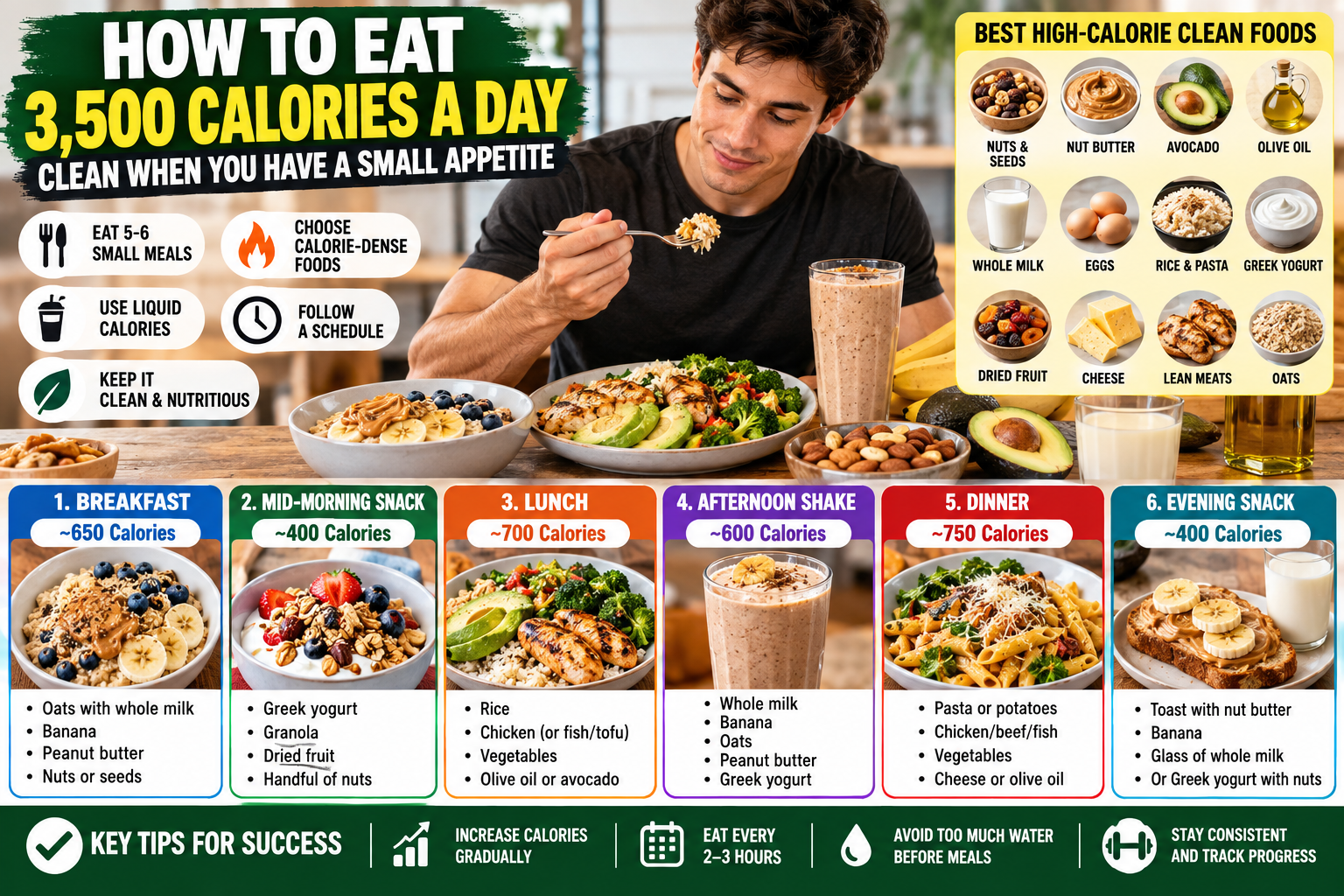

Eating 3,500 calories a day can feel impossible when you have a small appetite. Huge plates usually make the problem worse. You get full halfway through, miss the next meal, then spend the evening trying to catch up.
A better approach is calorie density.
Instead of making every meal bigger, make each bite deliver more energy. Eat more frequently. Use calorie-rich whole foods. Drink some calories between meals. Add compact ingredients such as nuts, nut butter, olive oil, avocado, dairy, eggs, rice, and dried fruit.
This approach matches common clinical advice for people struggling to eat enough. Smaller, frequent meals and calorie-dense additions can increase energy intake without demanding oversized portions. [Insert NHS Healthy Weight Reference Here]
The goal is simple: 3,500 calories should come from a manageable routine, not forced eating.
Why 3,500 Calories Feels So Hard With a Small Appetite
A person with a strong appetite might handle three 1,000-calorie meals plus snacks.
That can be miserable with a small appetite.
Large portions physically fill the stomach. High-volume foods can make reaching a high calorie target even harder. Drinking lots of fluid immediately before eating may also leave some people feeling too full to finish meals. [Insert NHS Small Appetite Reference Here]
So stop thinking:
“I need three massive meals.”
Think:
“I need six smaller calorie opportunities.”
A 3,500-calorie target split across six feedings averages about 583 calories each. Some can be smaller. Others can carry more calories.
That instantly makes the target less intimidating.
The Small-Appetite Formula for Reaching 3,500 Calories
| Eating Time | Example Calories |
|---|---|
| Breakfast | 650 |
| Mid-Morning Snack | 400 |
| Lunch | 700 |
| Shake | 600 |
| Dinner | 750 |
| Evening Snack | 400 |
| Daily Total | 3,500 |
You do not need to follow those numbers exactly.
The useful part is the distribution.
Eating five or six times removes the pressure to consume 1,000+ calories at once. Mayo Clinic similarly recommends eating more frequently and describes five to six smaller meals as one strategy for healthy weight gain. [Insert Mayo Clinic Reference Here]
Choose Clean Foods With More Calories Per Bite
A small appetite changes how you should build meals.
A giant salad might contain plenty of nutrients. Yet its large volume can fill you before you’ve consumed much energy.
For a high-calorie diet, choose nutritious foods that pack substantial calories into reasonable portions.
Good choices include:
- Nut butters: compact source of calories and fat.
- Nuts and seeds: easy additions to oats and yogurt.
- Olive oil: adds calories without much food volume.
- Avocado: useful in wraps, eggs, and sandwiches.
- Whole milk: provides calories, protein, and fluid.
- Greek yogurt: easy snack with protein.
- Whole eggs: compact and versatile.
- Rice and pasta: useful carbohydrate bases.
- Dried fruit: less bulky than fresh fruit.
- Cheese: easy way to enrich meals.
Adding calorie-rich ingredients to existing meals is especially useful because the portion does not need to grow dramatically. [Insert NHS Diet Fortification Reference Here]
Stop Eating Everything Plain
This is one of the easiest changes.
Suppose you already eat eggs and toast.
Don’t automatically add another huge plate of food.
Upgrade what is already there.
Cook the eggs with a little olive oil. Add cheese. Put nut butter on another slice of toast. Have whole milk alongside it.
The same principle works with rice.
Rice, chicken, and vegetables can be nutritious. Yet a very lean version may make reaching 3,500 calories unnecessarily difficult.
Add avocado, olive oil, tahini, cheese, nuts, or another suitable calorie-dense topping.
Small additions accumulate quickly across six meals.
Liquid Calories Can Make 3,500 Much Easier
Drinking some calories can be useful when chewing another full meal feels difficult.
Mayo Clinic specifically identifies nutritious smoothies and shakes as possible tools for healthy weight gain. [Insert Mayo Clinic Reference Here]
Try a homemade shake containing foods such as:
- Whole milk
- Banana
- Oats
- Peanut butter
- Greek yogurt
- Berries
Depending on portions, one shake can supply several hundred calories without resembling another full dinner.
Timing matters.
Don’t down a giant shake immediately before lunch if it destroys your appetite. Use calorie-containing drinks between meals instead. Clinical guidance for small appetites commonly recommends avoiding filling up on drinks just before meals. [Insert NHS Small Appetite Reference Here]
Example 3,500-Calorie Clean Eating Day
Here is a practical framework. Exact calories vary by brands and serving sizes, so weigh or measure foods when accuracy matters.
Breakfast — Around 650 Calories
Have oats cooked with whole milk.
Add banana and peanut butter. Sprinkle nuts or seeds on top.
This gives you carbohydrates, fats, protein, and substantial energy without requiring several separate dishes.
Mid-Morning Snack — Around 400 Calories
Have Greek yogurt with granola and dried fruit.
A small handful of nuts can increase calories without making the snack dramatically larger.
Lunch — Around 700 Calories
Build your meal around rice and a protein source.
Chicken, beef, fish, tofu, beans, or eggs can work depending on your diet.
Add vegetables and an energy-dense ingredient such as olive oil or avocado.
You now have a balanced meal without needing an enormous plate.
Afternoon Shake — Around 600 Calories
Blend whole milk, banana, oats, peanut butter, and yogurt.
Adjust ingredient amounts according to your calorie target.
This feeding is especially valuable when your appetite falls during the afternoon.
Dinner — Around 750 Calories
Choose pasta, potatoes, or rice as your carbohydrate base.
Add a quality protein source and vegetables.
Increase energy with olive oil, cheese, avocado, pesto, tahini, or another nutrient-rich addition that fits the meal.
Evening Snack — Around 400 Calories
Keep this easy.
Try toast with nut butter plus milk, or Greek yogurt with nuts and fruit.
You shouldn’t need to cook another dinner before bed.
Don’t Chase “Clean Eating” Too Aggressively
“Clean eating” has no single medical definition.
For this goal, it is more useful to think about nutrient quality, balance, and consistency.
Trying to eat 3,500 calories entirely from chicken breast, steamed vegetables, plain potatoes, and low-fat products can create enormous food volume.
That defeats the purpose when appetite is already limited.
Dietary fat is particularly useful because it is energy dense. Foods such as olive oil, nuts, seeds, avocado, and nut butter can raise calories without requiring massive portions.
Your overall diet should still include protein foods, carbohydrates, fruits, vegetables, and other nutrient-rich foods. [Insert NHS Healthy Weight Reference Here]
Eat on a Schedule Instead of Waiting for Hunger
Small-appetite eaters cannot always rely on hunger signals.
Create eating times.
For example:
7:30 a.m. — Breakfast
10:30 a.m. — Snack
1:00 p.m. — Lunch
4:00 p.m. — Shake
7:00 p.m. — Dinner
9:30 p.m. — Snack
You are eating roughly every two-and-a-half to three hours.
Clinical dietetic guidance for poor appetite often recommends eating small amounts every two to three hours rather than struggling through very large meals. [Insert NHS Dietitian Reference Here]
After several weeks, the routine may feel easier because you are no longer trying to rescue your calorie target late at night.
Increase Calories Gradually
Going straight from 2,000 calories to 3,500 overnight may be uncomfortable.
You don’t need to force the jump.
If weight gain is the goal, the NHS suggests adults may try adding roughly 300–500 calories per day and gaining weight gradually. [Insert NHS Healthy Weight Reference Here]
Your actual requirements may differ.
Start by identifying your current intake. Then add manageable calories through snacks, toppings, larger servings, or shakes.
This also lets you see whether 3,500 calories is genuinely necessary for your body and goal.
Common Mistakes That Make 3,500 Calories Harder
- Huge meals: smaller feedings may be easier.
- Too much water: avoid filling up right before meals.
- Ultra-lean foods: they can create unnecessary volume.
- Skipping breakfast: leaves too many calories for later.
- Waiting for hunger: use planned eating times.
- Ignoring liquids: shakes can provide useful calories.
- Changing overnight: increase intake progressively.
What If You Still Cannot Eat Enough?
A consistently poor appetite deserves attention.
If you’re losing weight without trying, your appetite has changed significantly, or eating enough has become persistently difficult, speak with a doctor or registered dietitian. Unexpected weight loss can have underlying causes that need assessment. [Insert Mayo Clinic Reference Here] [Insert NHS Healthy Weight Reference Here]
People with conditions such as diabetes, kidney disease, digestive disorders, or other medical dietary requirements may also need an individualized plan rather than a generic 3,500-calorie diet.
The number itself is not the goal.
Meeting your body’s actual nutritional needs is.
A Simpler Way to Think About 3,500 Calories
You don’t beat a small appetite by making every plate enormous.
You work around it.
Eat five or six times daily. Choose compact calorie sources. Add energy to foods you already enjoy. Use nutritious shakes between meals. Keep convenient snacks ready.
Most importantly, build your intake gradually.
A 3,500-calorie day becomes far more manageable when those calories are spread across the entire day instead of squeezed into three oversized meals.
Quick Takeaways
- Eat more frequently: aim for several smaller feedings.
- Increase calorie density: use nuts, oils, dairy, and avocado.
- Drink useful calories: place nutritious shakes between meals.
- Build gradually: don’t force an immediate 3,500-calorie jump.
Disclaimer: This article is based on established public nutrition guidance and reputable health sources. It is intended for general educational and informational purposes and does not replace personalized advice from a doctor or registered dietitian.
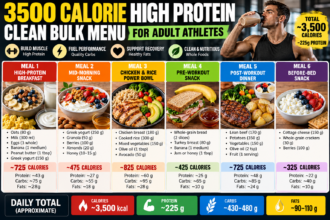
Read more:3500 Calorie High Protein Clean Bulk Menu for Adult Athletes