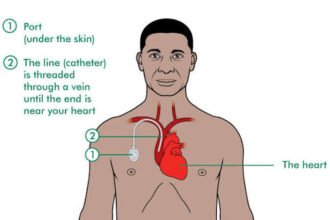


A chemo port incision should gradually heal after placement.
New redness, warmth, swelling, drainage, or worsening pain needs attention.

At a Glance
| Detail | Important Information |
|---|---|
| Topic | Chemo port incision infection |
| Main concern | Infection around the surgical incision |
| Common warning signs | Redness, warmth, swelling, drainage, pain |
| Systemic warning sign | Fever or chills |
| Higher-risk period | During chemotherapy and low white-cell counts |
| Recommended action | Contact your cancer care team |
| Emergency concern | Fever with severe illness or rapidly worsening symptoms |
What Is a Chemo Port Incision?
A chemo port is a small device placed under the skin.
A catheter connects it to a large vein.
Doctors use ports for chemotherapy and blood draws.
The port usually sits beneath the skin.
The incision closes after the placement procedure.
Normal healing should gradually reduce redness and discomfort.
The important point is change over time.
A healing incision should generally improve, not worsen.
New or increasing symptoms deserve medical attention.

Signs of Infection in a Chemo Port Incision Line
Several changes can indicate infection around the incision.
These signs can appear separately or together.
1. Increasing Redness
Some redness can occur shortly after surgery.
However, redness that spreads or becomes worse matters.
Watch for redness extending beyond the incision edges.
Red streaking can also require prompt medical evaluation.
2. Increasing Warmth
An infected incision may feel unusually warm or hot.
Warmth becomes more concerning with redness or swelling.
Compare the area with nearby skin.
A noticeable increase in warmth should be reported.
3. Swelling Around the Incision
Mild swelling can occur after port placement.
Increasing swelling is more concerning than stable swelling.
Contact your healthcare team if swelling keeps increasing.
A growing bruise or painful swelling also deserves attention.
4. Pus or Unusual Drainage
Drainage is one of the clearer warning signs.
Pus or cloudy fluid should not be ignored.
A bad smell can also indicate wound infection.
Tell your healthcare provider about any unusual drainage.
5. Increasing Pain or Tenderness
Some soreness is expected after the procedure.
Pain should generally improve as healing continues.
New or increasing pain can signal a problem.
Tenderness with warmth or redness is especially important.
6. The Incision Starts Opening
A healing incision should remain closed.
An opening can increase infection risk.
Contact your medical team if the incision separates.
Do not pull, squeeze, or manipulate the wound yourself.
Fever and Chills Can Be More Serious
An infection may cause symptoms beyond the port area.
These can include fever and chills.
The National Cancer Institute emphasizes infection risks during chemotherapy.
Chemotherapy can reduce infection-fighting white blood cells.
Memorial Sloan Kettering advises contacting healthcare providers at 100.4°F (38°C) or higher.
Do not assume fever is simply a chemotherapy side effect.
Your oncology team should assess unexplained fever promptly.
Quick Comparison: Healing or Possible Infection?
| Healing Pattern | Concerning Pattern |
|---|---|
| Pain gradually improves | Pain becomes stronger |
| Redness gradually fades | Redness spreads |
| Swelling decreases | Swelling increases |
| Incision stays closed | Incision starts opening |
| No unusual drainage | Pus or cloudy drainage |
| No fever | Fever or chills |
| Skin becomes less tender | Increasing tenderness |
This comparison is not a diagnosis.
Your surgical and oncology teams know your specific situation.
Why Infection Risk Matters During Chemotherapy
Chemotherapy can lower certain white blood cell counts.
This can weaken the body’s ability to fight infections.
That makes seemingly minor symptoms more important.
An infection can potentially spread beyond the incision.
The NCI recommends contacting your healthcare team for infection signs.
This includes redness or swelling around catheter areas.
What Should You Do If You Notice These Signs?
Do not wait several days to see what happens.
Contact your oncology or surgical team promptly.
Until you receive instructions:
- Keep the area clean and protected.
- Wash your hands before touching the area.
- Do not squeeze drainage or pus.
- Do not apply creams without medical advice.
- Do not remove or manipulate the port yourself.
- Monitor your temperature if you feel unwell.
Cleveland Clinic also recommends good hand hygiene.
Handwashing helps reduce infection risk around implanted ports.
When Should You Seek Urgent Medical Help?
Contact your cancer care team urgently for significant symptoms.
These include fever, chills, spreading redness, or drainage.
Prompt attention is especially important during chemotherapy.
Infections can become serious when immunity is reduced.
Seek emergency care if you become severely unwell.
This includes symptoms such as confusion, breathing difficulty, or extreme weakness.
Your cancer center may have its own fever instructions.
Always follow those instructions over general online guidance.
An Often-Missed Point About Incision Changes
The direction of change can matter as much as appearance.
An incision that looks slightly pink may be healing.
An incision becoming progressively redder is different.
Likewise, mild soreness can follow port placement.
Pain that increases after initially improving deserves attention.
This is why daily observation can be useful.
It helps you notice meaningful changes early.
Frequently Asked Questions
Can a chemo port incision become infected?
Yes, infection can occur around an implanted port.
Possible signs include redness, warmth, swelling, pain, or drainage.
Fever and chills can indicate a more significant infection.
Is redness around a port incision always an infection?
No, mild redness can occur during normal healing.
The pattern and progression are more important.
Redness that spreads or becomes worse needs medical assessment.
What does infected port drainage look like?
Concerning drainage may appear thick or cloudy.
Pus or unpleasant-smelling fluid is particularly concerning.
Contact your healthcare provider if drainage develops.
What temperature is concerning during chemotherapy?
Many cancer centers treat 100.4°F (38°C) as important.
Memorial Sloan Kettering specifically recommends calling at that temperature.
Your oncology team may give different instructions.
Follow their instructions if they use another threshold.
Can I treat a suspected port infection at home?
A suspected port infection should not be self-treated.
Your healthcare team may need to examine the incision.
They may also determine whether testing or treatment is necessary.
Final Takeaway
The key warning signs are worsening redness, warmth, swelling, pain, drainage, and fever.
During chemotherapy, infection deserves prompt medical attention.
If your incision is changing, contact your care team.
Do not rely on appearance alone to rule out infection.
Read more :How Long After Chemo Port Removal Can You Lift Weights?