
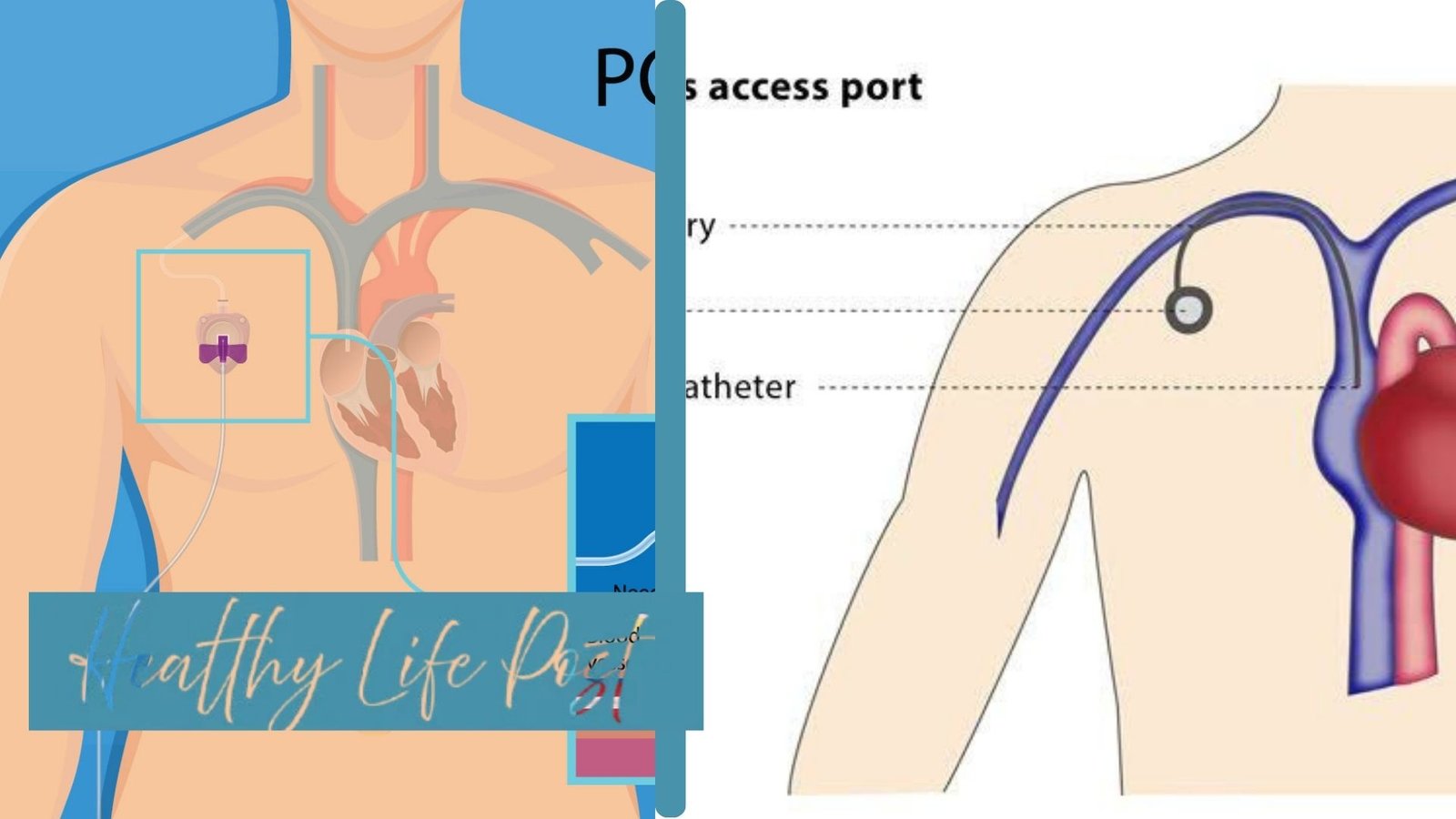

Accessing port means using a special needle to reach an implanted medical port.
It allows healthcare professionals to give medicines or draw blood safely.
At a Glance
| Detail | Information |
|---|---|
| Medical term | Accessing an implanted venous port |
| Common names | Port-a-Cath, Mediport, implanted port |
| Main purpose | IV medicines, fluids, transfusions, and blood draws |
| Access method | Special non-coring needle |
| Typical location | Chest, arm, or abdomen |
| Who performs it? | Trained healthcare professionals |
| Main safety concern | Infection and port complications |
| Patient self-access | Only with appropriate professional training |
| Key advantage | Reduces repeated peripheral needle sticks |
| Source status | Information verified against clinical sources |
What Is Accessing Port?
Accessing a port is a clinical procedure. It reaches an implanted venous access device under the skin. The device connects to a large vein through a catheter. Healthcare professionals use it for repeated treatments.
The port contains a self-sealing silicone section. This section is called the septum. A special needle passes through the septum. It then connects with the port’s internal chamber.
Unlike a regular IV, nothing remains outside the body. The port stays beneath the skin when unused. This design can make long-term vascular access more convenient.
Why Do Patients Need an Implanted Port?
Ports are useful when treatments require repeated vein access. They can support several types of medical care. Their use is not limited to cancer treatment.
Common reasons include:
- Chemotherapy and other cancer treatments
- Long-term intravenous antibiotics
- Repeated blood tests
- Blood or platelet transfusions
- Certain IV fluids and medications
- Some nutritional treatments
- Selected long-term medical conditions
The main advantage is fewer repeated peripheral needle sticks. A port can also provide reliable access during lengthy treatment plans.
How Accessing a Port Works
The process follows strict infection-control practices. A trained professional first prepares the access area. The skin is cleaned with an appropriate antiseptic.
A special needle then enters the port through its septum. The professional may use a numbing cream when appropriate. The port can then be used for treatment or blood collection.
The exact technique can vary by device and facility. Port type also affects the procedure. Some ports have one access chamber. Others have two separate lumens.
What Happens After Access?
A sterile dressing may cover the accessed port. This helps protect the area during treatment. Healthcare staff also monitor the site for possible problems.
When treatment ends, the needle can be removed. The site is then covered appropriately. If ongoing treatment requires the needle to remain, additional secure dressing is used.
Accessing Port Is Different From Port Placement
These two terms describe different procedures.
Port placement involves surgically inserting the device. The catheter is positioned inside a large vein. The port itself sits beneath the skin.
Port accessing happens after the device already exists. A special needle reaches the implanted chamber. This allows medical staff to use the established vascular access.
This distinction matters when reading medical records. “Port placement” does not mean the port was simply accessed.
Who Can Access an Implanted Port?
Port access requires appropriate clinical training. It is not the same as inserting an ordinary peripheral IV. Infection prevention and device assessment are important parts of the process.
Patients should follow their healthcare facility’s instructions. Rules can differ by country, hospital, device, and clinical setting. MedlinePlus specifically describes access by a trained provider.
For this reason, people should not attempt port access independently. Training and professional authorization are essential.
Safety Risks and Warning Signs
An implanted port can provide long-term access. However, complications can still occur. Infection is among the most important concerns. Other problems include blockage, blood clots, and catheter complications.
Patients should contact their healthcare provider if they notice:
- Fever or chills
- Redness around the port
- Swelling or warmth
- Unusual drainage
- Increasing pain
- Changes in the port’s position
- Difficulty accessing the port
- Swelling of the nearby arm
MedlinePlus lists fever above 100.5°F (38°C) among warning signs. It also advises reporting redness, swelling, warmth, drainage, or access problems.
An Overlooked Point: The Port Is Designed for Long-Term Access
One important feature is its durability. An implanted port can remain in place for years when clinically needed. Cleveland Clinic notes that ports can tolerate many needle accesses.
The benefit is therefore bigger than convenience alone. The device creates a repeatable route into the bloodstream. This can matter greatly for people receiving frequent treatments.
Its design also keeps the device completely beneath the skin. That differs from several external central-line systems. The reduced external hardware can simplify daily life for some patients.
Port Care Between Treatments
An unused port still needs appropriate maintenance. Healthcare providers may flush it periodically. The schedule depends on the device and clinical instructions.
Patients should also maintain good hygiene. They should follow the care plan provided by their medical team. Instructions can differ based on treatment and individual circumstances.
Important Privacy and Medical Note
There is no personal biography attached to the phrase “accessing port.” It is a medical procedure, not a person’s name. Therefore, details such as birth name, marriage, family, education, or net worth do not apply.
That distinction is important for accurate SEO content. Adding invented personal details would create misinformation. This article instead focuses on verified medical information.
Final Takeaway
Accessing port is a routine but specialized clinical procedure. It allows trained professionals to use an implanted vascular access device. Ports can support repeated treatments while reducing peripheral needle sticks.
The most important issue remains safe handling. Proper access technique helps reduce infection and device-related complications. Patients should always follow their healthcare provider’s instructions.
SEO Title: Accessing Port: How It Works and What to Know
Meta Description: Accessing port explained simply: learn how implanted ports work, why they are used, safety concerns, and important care information.