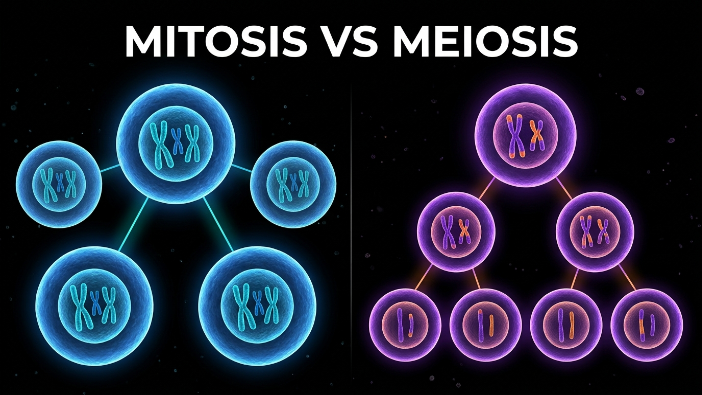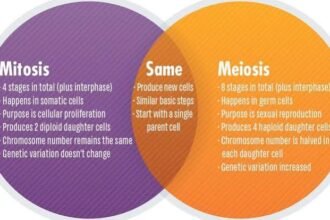

Mitosis vs meiosis are two forms of cell division with different purposes. Mitosis produces two genetically similar cells for growth and tissue maintenance. Meiosis produces genetically varied reproductive cells with half the usual chromosome number.
In simple terms, mitosis maintains the body, while meiosis helps create eggs and sperm for sexual reproduction. Both processes involve chromosomes, but they differ in the number of divisions, final cells, and sources of genetic variation.
Mitosis vs Meiosis at a Glance
| Feature | Mitosis | Meiosis |
|---|---|---|
| Main purpose | Growth and tissue maintenance | Production of eggs and sperm |
| Starting cell | Usually a diploid body cell | Diploid germ cell |
| DNA replication | Once before division | Once before meiosis I |
| Number of divisions | One | Two |
| Cells produced | Two | Usually four |
| Chromosomes in final human cells | Usually 46 | 23 |
| Final chromosome state | Usually diploid | Haploid |
| Genetic makeup | Usually similar | Genetically varied |
| Homologous chromosome pairing | Does not normally occur | Occurs during meiosis I |
| Crossing over | Not a normal feature | Occurs during prophase I |
| First chromosomes separated | Sister chromatids | Homologous chromosomes |
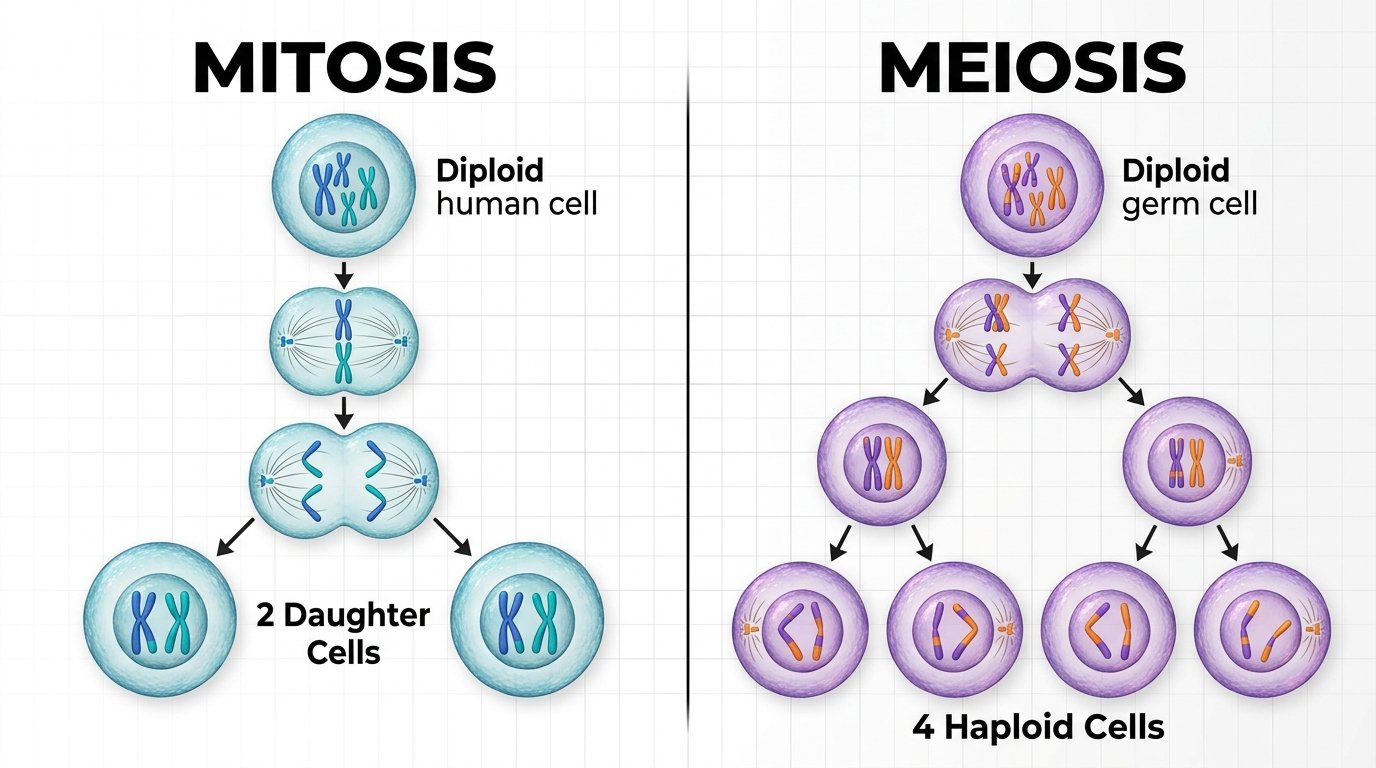
Quick answer: Mitosis uses one division to create two similar cells. Meiosis uses two divisions to create four genetically varied haploid cells.
Why Do Cells Need to Divide?
The human body begins as a single fertilized egg. That cell must divide repeatedly to produce the many cells required for development.
Cell division remains important throughout life. It helps maintain tissues and replace certain old, damaged, or worn-out cells. The body also needs a specialized process to produce reproductive cells.
These needs explain the two forms of cell division:
- Mitosis supports growth and tissue maintenance.
- Meiosis produces eggs and sperm.
- Fertilization combines the chromosome sets from two reproductive cells.
Most human body cells are diploid. This means they normally contain two sets of chromosomes. One set came from each biological parent.
A typical human body cell contains 46 chromosomes arranged in 23 pairs. A mature egg or sperm contains 23 chromosomes and is therefore haploid.
When an egg and sperm combine, they usually create a fertilized egg with 46 chromosomes. Meiosis prevents the chromosome number from doubling in every generation.
What Is Mitosis?
Mitosis is the division of a cell’s nucleus. During this process, duplicated chromosomes separate into two nuclei.
Cytokinesis usually follows mitosis. Cytokinesis divides the cytoplasm and other cellular material, producing two separate daughter cells.
In humans, a typical diploid cell with 46 chromosomes generally produces two daughter cells with 46 chromosomes each. The National Human Genome Research Institute explains that mitosis normally produces two cells with equivalent genomes.
Mitosis contributes to:
- Growth during development
- Maintenance of many tissues
- Replacement of certain aging cells
- Some aspects of wound healing
- Asexual reproduction in certain organisms
Mitosis does not mean every daughter cell remains perfectly identical forever. DNA-copying errors and new mutations can occur. Cells can also develop different patterns of gene activity as they specialize.
Nevertheless, controlled mitosis normally gives both daughter cells equivalent chromosome sets.
The Cell Cycle Before Mitosis
Mitosis is only one part of the broader cell cycle. A cell spends much of its time in interphase, preparing for possible division.
Interphase includes three major stages:
- G1 phase: The cell grows and performs regular functions.
- S phase: The cell copies its DNA.
- G2 phase: The cell continues growing and checks its preparation.
After DNA replication, each chromosome consists of two attached copies called sister chromatids. The cell must separate these chromatids accurately during mitosis.
Not every cell continuously moves through this cycle. Some cells enter a resting or nondividing state called G0. Different tissues also have very different rates of cell replacement.
Stages of Mitosis Explained
Mitosis follows an organized sequence. Textbooks sometimes group the stages slightly differently, particularly prometaphase.
Prophase
Chromosomes condense and become easier to distinguish. Each duplicated chromosome contains two sister chromatids joined near a region called the centromere.
The cell also begins constructing the mitotic spindle. This structure helps organize and move chromosomes.
Prometaphase
Many textbooks treat prometaphase as part of late prophase. During this stage, the nuclear envelope breaks down.
Spindle fibers can then attach to protein structures located at the chromosome centromeres.
Metaphase
Duplicated chromosomes align individually near the middle of the cell. This location is often called the metaphase plate.
Cellular checkpoints help confirm that chromosomes have properly attached to spindle fibers. Correct attachment lowers the risk of unequal chromosome distribution.
Anaphase
The connections between sister chromatids are released. Spindle fibers then move the chromatids toward opposite sides of the cell.
Once separated, each chromatid functions as an individual chromosome.
Telophase
The separated chromosomes reach opposite ends of the cell. New nuclear envelopes form around the two chromosome sets.
The chromosomes also begin returning to a less condensed state.
Cytokinesis
Cytokinesis separates the remaining cell contents. The result is two individual daughter cells.
Mitosis technically describes nuclear division. Cytokinesis completes division of the entire cell.
Mitosis Process in Simple Steps
The overall sequence can be summarized as follows:
- A diploid cell copies its DNA.
- Duplicated chromosomes condense.
- Chromosomes align individually.
- Sister chromatids separate.
- Two new nuclei form.
- Cytokinesis creates two daughter cells.
The chromosome number is normally maintained. A typical human cell that begins with 46 chromosomes therefore produces two cells containing 46 chromosomes each.
What Is Meiosis?
Meiosis is a specialized type of cell division involved in sexual reproduction. In humans, germ cells undergo meiosis while developing into eggs or sperm.
DNA replicates once before meiosis begins. However, the cell then completes two divisions:
- Meiosis I
- Meiosis II
These divisions generally produce four haploid cells from one diploid starting cell. Each final cell contains one chromosome from every original homologous pair.
MedlinePlus explains that meiosis reduces the human chromosome number from 46 to 23. It also reshuffles genetic material, contributing to variation among offspring.
Human egg development differs from the simple four-equal-cells illustration found in many textbooks. Cytoplasm is divided unevenly, generally producing one functional ovum and smaller polar bodies. Sperm development more closely resembles the four-cell model.
Meiosis I: Separating Homologous Chromosomes
Meiosis I reduces the number of chromosome sets. For that reason, scientists sometimes call it a reduction division.
Prophase I
Prophase I is longer and more complex than mitotic prophase. Homologous chromosomes pair with one another.
A homologous pair contains corresponding chromosomes inherited from each biological parent. The chromosomes carry the same categories of genes, although they may contain different versions of those genes.
Paired chromosomes may exchange corresponding DNA segments through crossing over. This process is also called genetic recombination.
Crossing over creates new combinations of genetic variants. It is one reason reproductive cells from the same person are genetically different.
Metaphase I
Homologous chromosome pairs align together near the center of the cell.
Each pair can face either direction independently of the other pairs. This random orientation contributes to independent assortment, another source of genetic variation.
Anaphase I
Homologous chromosomes separate and move toward opposite poles. However, the sister chromatids remain attached.
This is a major difference between meiosis I and mitosis. Mitosis separates sister chromatids directly, while meiosis I separates homologous chromosomes.
Telophase I and Cytokinesis
The chromosomes reach opposite sides, and the cell divides. Two cells form, each containing one chromosome from every original homologous pair.
However, every chromosome still consists of two sister chromatids.
Meiosis II: Separating Sister Chromatids
DNA does not replicate again before meiosis II. The two cells created during meiosis I proceed into another division.
Prophase II
Chromosomes condense if they relaxed after meiosis I. Spindle structures form within both cells.
Metaphase II
The chromosomes align individually at the center of each cell. Their arrangement now resembles metaphase in mitosis.
Anaphase II
The sister chromatids separate. They move toward opposite poles and become individual chromosomes.
Telophase II and Cytokinesis
Nuclear envelopes may form around the separated chromosome sets. Cytokinesis then divides both cells.
The original diploid cell has now generally produced four haploid cells. Each contains a genetically distinct chromosome combination.
Meiosis Process in Simple Steps
The complete process follows this sequence:
- A diploid germ cell copies its DNA once.
- Homologous chromosomes pair.
- Crossing over may exchange DNA.
- Homologous pairs align randomly.
- Meiosis I separates the homologous chromosomes.
- Meiosis II separates the sister chromatids.
- Four genetically varied haploid cells usually form.
In humans, the chromosome number changes from 46 in the original diploid cell to 23 in each mature reproductive cell.
Major Differences Between Mitosis and Meiosis
1. Purpose
Mitosis produces new cells for growth and tissue maintenance. Meiosis produces cells involved in sexual reproduction.
2. Number of Divisions
Mitosis completes one nuclear division. Meiosis completes two divisions after a single round of DNA replication.
3. Number of Final Cells
One mitotic division normally produces two cells. Meiosis generally produces four haploid cells.
Human egg formation is an important qualification. It usually produces one functional ovum and smaller polar bodies rather than four equal functional eggs.
4. Chromosome Number
Mitosis normally maintains the original chromosome number. A diploid cell generally produces diploid daughter cells.
Meiosis reduces the chromosome number by half. A diploid germ cell produces haploid reproductive cells.
5. Genetic Variation
Mitosis usually creates daughter cells with equivalent chromosome sets. This consistency helps tissues maintain their functions.
Meiosis produces genetic variation through two major processes:
- Crossing over during prophase I
- Independent assortment during metaphase I
Random fertilization increases variation further, although it occurs after meiosis.
6. Chromosome Behavior
During mitotic metaphase, duplicated chromosomes align individually. Their sister chromatids then separate during anaphase.
During metaphase I of meiosis, homologous pairs align together. Homologous chromosomes separate during anaphase I. Individual chromosomes align later during metaphase II, and sister chromatids separate during anaphase II.
Genetic Variation: Why Meiosis Is Different
Meiosis does more than reduce chromosome number. It also creates many possible genetic combinations.
Crossing Over
During prophase I, paired homologous chromosomes may exchange corresponding DNA segments. The resulting chromosomes contain new combinations of genetic variants.
Crossing over rearranges existing genetic information. It is not the same as a mutation, which changes the DNA sequence.
Independent Assortment
Each homologous pair can orient in different directions during metaphase I. Therefore, chromosome pairs are distributed independently into the developing reproductive cells.
This random distribution creates many possible chromosome combinations.
Random Fertilization
Any one sperm may combine with an available egg. This random pairing creates even more variation in the resulting offspring.
Together, these processes help explain why siblings with the same biological parents are usually genetically different. Identical twins are a special case because they develop after one fertilized egg separates into two embryos.
What Mitosis and Meiosis Have in Common
Mitosis and meiosis have different outcomes, but they share several basic features:
- Both are forms of cell division.
- DNA normally replicates before division begins.
- Chromosomes condense before separation.
- Spindle structures move chromosomes.
- Both include named phases such as prophase and metaphase.
- Cellular checkpoints help monitor chromosome distribution.
- Cytokinesis commonly follows nuclear division.
The shared stage names do not mean the events are identical. Metaphase I of meiosis, for example, aligns homologous chromosome pairs. Mitotic metaphase aligns individual duplicated chromosomes.
Medical and Health Impact: When Cell Division Goes Wrong
Cell division requires tightly controlled molecular systems. Cells must copy DNA, attach chromosomes to spindle fibers, and distribute chromosomes accurately.
Errors may still occur. Their effects depend on the affected cell, chromosome, timing, and whether the body corrects or removes the abnormal cell.
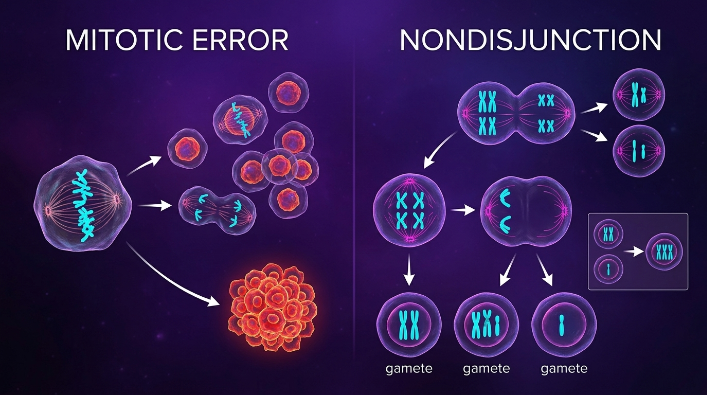
Mitosis Errors and Cancer
Genes control when cells grow, divide, repair damage, or die. Changes affecting these controls may allow abnormal cells to continue multiplying.
Problems involving mitosis can contribute to:
- Abnormal chromosome numbers
- Unequal chromosome distribution
- DNA damage
- Chromosome instability
- Loss of normal cell-cycle control
- Continued growth of abnormal cells
Uncontrolled cell division is an important feature of cancer and tumor growth. However, one faulty mitotic division does not automatically cause cancer.
Cancer usually develops through multiple accumulated genetic and cellular changes. These changes may affect growth signals, DNA repair, cell death, and immune-system recognition.
Many abnormal cells stop dividing or die. The body may also repair or remove them. Disease may develop when certain altered cells survive and escape normal growth controls.
Therefore, it is more accurate to say mitotic and cell-cycle errors can contribute to cancer development, rather than describing one failed mitosis as the single cause of cancer.
Meiosis Errors and Nondisjunction
Homologous chromosomes must separate during meiosis I. Sister chromatids must then separate during meiosis II.
Sometimes chromosomes fail to separate correctly. Scientists call this error nondisjunction.
Nondisjunction can produce an egg or sperm with an extra or missing chromosome. If that reproductive cell participates in fertilization, the embryo may have an atypical chromosome number.
Examples include:
- Down syndrome: Most cases involve three copies of chromosome 21, called trisomy 21.
- Turner syndrome: Usually involves one X chromosome instead of the typical two sex chromosomes.
- Klinefelter syndrome: Usually involves an additional X chromosome, resulting in an XXY pattern.
- Edwards syndrome: Caused by an additional copy of chromosome 18.
- Patau syndrome: Caused by an additional copy of chromosome 13.
Not every case develops through the same biological mechanism. For example, Down syndrome can also involve a chromosome translocation. Some cases result from a post-fertilization mitotic error and produce mosaicism.
Chromosomal conditions also differ widely in their features and medical effects. An educational article cannot predict an individual outcome.
People with questions about prenatal screening, fertility, recurrent pregnancy loss, or genetic tests should consult a qualified healthcare professional or genetic counselor.
Mitotic Errors and Mosaicism
Chromosome-separation errors can occur during mitosis after fertilization. When this happens, one group of cells may have a different chromosome pattern from another group.
This situation is known as mosaicism.
Its effects depend on several factors:
- When the error occurred
- Which chromosome was affected
- How many cells carry the difference
- Which organs or tissues contain those cells
A blood test may not always represent every tissue in the body. A healthcare professional may recommend further testing when mosaicism is suspected.
Can Cell-Division Errors Be Prevented?
Not every cell-division error is preventable. Many occur spontaneously without anything a person did or failed to do.
The body uses checkpoints, DNA-repair systems, and programmed cell death to reduce harmful errors. However, these protective mechanisms are not perfect.
General health measures can support overall well-being, but they cannot guarantee error-free cell division. No food, supplement, or lifestyle plan can completely prevent all chromosome abnormalities or cancers.
Anyone concerned about inherited risk, pregnancy screening, or a family history of genetic conditions should seek individualized medical guidance.
Common Misconceptions
Meiosis Is Just Mitosis Happening Twice
This is incorrect. Meiosis I includes homologous pairing, crossing over, and separation of chromosome pairs. These events do not normally define mitosis.
DNA Replicates Twice During Meiosis
DNA normally replicates once before meiosis I. It does not replicate again between meiosis I and meiosis II.
Mitosis Always Produces Perfect Clones
Controlled mitosis normally distributes equivalent chromosome sets. However, DNA changes and replication errors may create differences between daughter cells.
Meiosis Always Produces Four Functional Gametes
This description more closely fits sperm formation. Human egg formation usually produces one functional ovum and smaller polar bodies.
Every Chromosome Condition Comes From Meiosis
Many chromosome-number conditions result from meiotic nondisjunction, but not all do. Mitotic errors after fertilization and structural chromosome rearrangements can also contribute.
Every Mitotic Error Causes Cancer
Most errors do not automatically produce cancer. Cancer usually requires several changes that allow altered cells to survive, multiply, and avoid normal controls.
Easy Way to Remember Mitosis vs Meiosis
Associate the terms with their main jobs:
- Mitosis = maintenance
- Meiosis = making reproductive cells
You can also remember their numbers:
- Mitosis: one division produces two cells.
- Meiosis: two divisions usually produce four cells.
The number shortcut is helpful, but it does not show the complete difference. Chromosome pairing, crossing over, and reduced chromosome number are also central features of meiosis.
Test Your Knowledge
1. Which process normally produces two daughter cells?
A. Meiosis
B. Mitosis
C. Fertilization
D. Crossing over
Answer: B. Mitosis normally produces two daughter cells.
2. How many chromosomes does a typical human egg or sperm contain?
A. 23
B. 46
C. 69
D. 92
Answer: A. A mature human egg or sperm normally contains 23 chromosomes.
3. When does crossing over usually occur?
A. Mitotic anaphase
B. Prophase I of meiosis
C. Meiosis II cytokinesis
D. After fertilization
Answer: B. Crossing over normally occurs during prophase I.
4. What separates during meiosis I?
A. Individual genes
B. Homologous chromosomes
C. Cell membranes
D. Sister chromatids only
Answer: B. Homologous chromosome pairs separate during meiosis I.
5. What is nondisjunction?
A. Normal DNA replication
B. Failure of chromosomes to separate correctly
C. Formation of a cell membrane
D. Exchange of DNA during crossing over
Answer: B. Nondisjunction occurs when chromosomes fail to separate properly.
Frequently Asked Questions
What is the main difference between mitosis and meiosis?
Mitosis produces two genetically similar cells and usually maintains chromosome number. Meiosis produces genetically varied haploid cells for sexual reproduction.
Where does mitosis occur in humans?
Mitosis occurs in many body tissues. However, different cell types divide at different rates, and some mature cells rarely divide.
Where does meiosis occur?
Meiosis occurs in germ cells within the ovaries or testes during egg or sperm development.
Why are four cells produced in meiosis?
DNA replicates once, but the cell divides twice. Meiosis I separates homologous chromosomes, while meiosis II separates sister chromatids.
Does meiosis cause genetic variation?
Yes. Crossing over and independent assortment produce different genetic combinations in eggs and sperm. Random fertilization adds further variation.
Can errors happen during both processes?
Yes. Mitotic errors may contribute to cancer, abnormal chromosome numbers, or mosaicism. Meiotic errors may produce reproductive cells with extra or missing chromosomes.
Conclusion
The central difference in mitosis vs meiosis is their biological purpose. Mitosis uses one division to produce two genetically similar cells for growth and tissue maintenance. Meiosis uses two divisions to produce genetically varied haploid cells involved in reproduction.
Mitosis normally preserves the chromosome number. Meiosis reduces it by separating homologous chromosomes during the first division and sister chromatids during the second. Crossing over and independent assortment also make meiosis an important source of genetic variation.
Both processes require accurate chromosome distribution. When their control systems fail, mitotic errors may contribute to cancer or mosaicism. Meiotic errors may produce eggs or sperm with abnormal chromosome numbers. However, the medical outcome depends on the specific error and biological context.
Scientific Sources
- National Human Genome Research Institute: Mitosis
- National Human Genome Research Institute: Meiosis
- National Human Genome Research Institute: Crossing Over
- MedlinePlus Genetics: How Do Cells Divide?
- National Center for Biotechnology Information: Meiosis and Fertilization
- National Human Genome Research Institute: Chromosome Abnormalities Fact Sheet
Author and Fact-Checking Box
Written by: [Author’s real name], Health and Science Content Writer
Fact-checked by: [Reviewer’s real name and genuine qualification]
Last reviewed: August 16, 2026
This article provides general educational information. It does not replace medical advice, diagnosis, genetic counseling, or treatment.
Do not add “medically reviewed” unless a qualified professional genuinely reviewed the article.
Read more :Ashwagandha Gummies: Benefits, Safety, Uses, and Buying Guide