
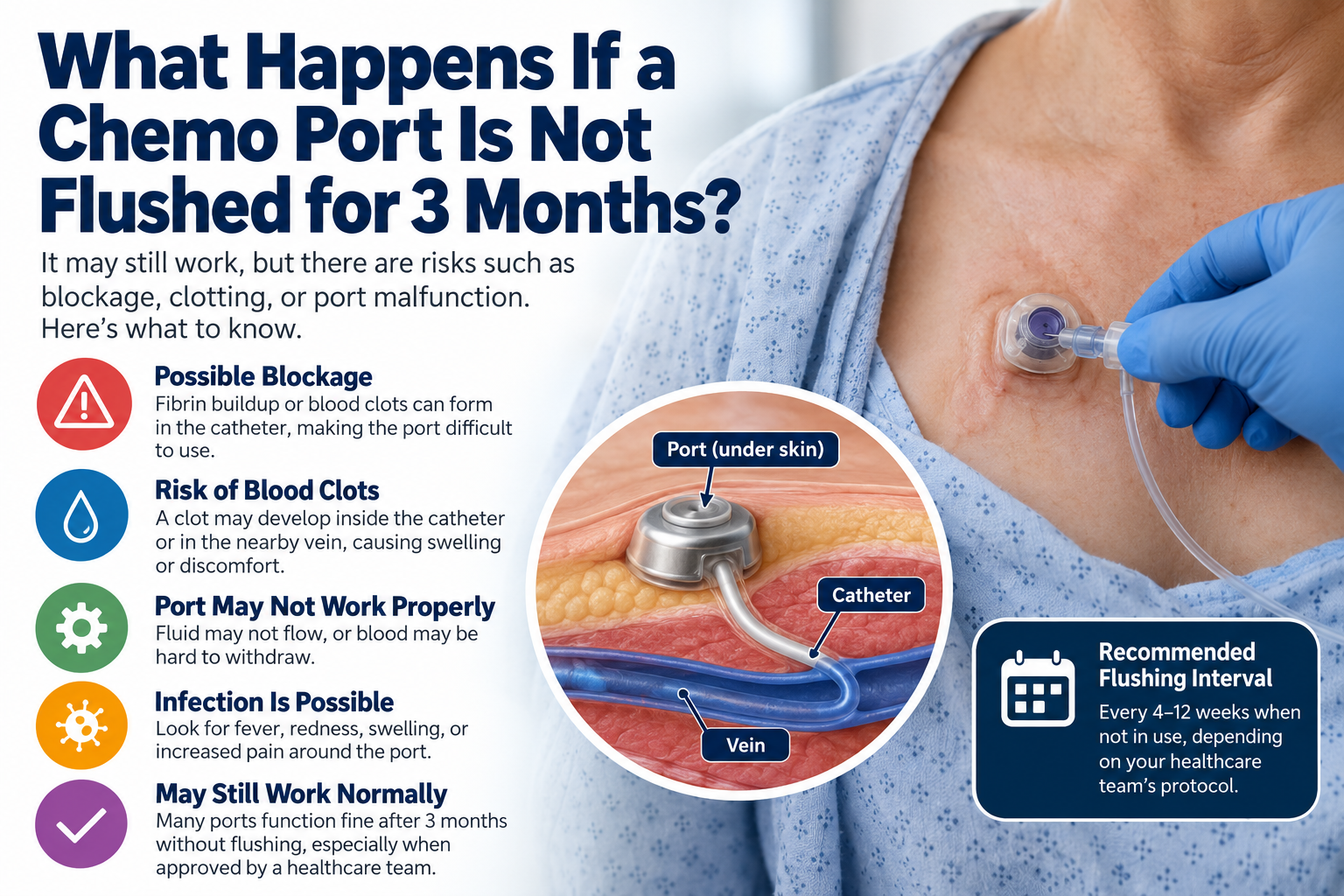

If a chemo port is not flushed for three months, it does not automatically mean the port is damaged or unsafe. However, blood clots, fibrin buildup, or catheter blockage may develop, making the device difficult to use. The actual risk depends on the type of port, its condition, and the maintenance schedule recommended by the healthcare team.
Some cancer centers recommend flushing an unused implanted port every four weeks, while others allow intervals of up to 12 weeks. Research suggests that three-month flushing schedules can be safe for selected patients who are no longer receiving active cancer treatment.
If your port has not been flushed for three months, contact your oncology team to arrange an assessment. Do not attempt to flush it yourself or force fluid through a port that may be blocked.
Understanding Why a Chemo Port Needs Regular Flushing
A chemotherapy port is a small medical device placed beneath the skin, usually in the upper chest. It connects to a thin catheter that leads into a large vein near the heart.
Doctors use these ports to deliver chemotherapy, other intravenous medications, fluids, and sometimes blood products. The device can also make repeated blood sampling easier for patients who need long-term treatment.
Unlike a standard IV line, an implanted port can remain in place for months or years. However, it still requires maintenance, even when a patient temporarily stops receiving treatment.
Flushing involves passing a sterile solution through the port to help maintain an open pathway. Healthcare professionals commonly use normal saline, while certain devices or institutional protocols may also require a heparin locking solution.
Without appropriate maintenance, material may accumulate inside the catheter. Over time, this can interfere with fluid delivery or prevent blood from being withdrawn.
Chemo Port Maintenance at a Glance
| Feature | Important information |
|---|---|
| Medical device | Totally implanted venous access port |
| Main purpose | Long-term intravenous treatment and blood access |
| Common flushing interval | Every 4–12 weeks when not in use, depending on protocol |
| Three months without flushing | Not automatically dangerous, but requires checking against the care plan |
| Potential complications | Blockage, fibrin buildup, thrombosis, or port malfunction |
| Common flushing solution | Sterile normal saline |
| Who should flush it? | A trained healthcare professional |
| What to do after a missed flush | Contact the oncology or infusion team |
What Happens If a Chemo Port Is Not Flushed for 3 Months?
The most important consideration is whether the port remains open and functions correctly.
Many implanted ports continue working normally after three months without flushing. Nevertheless, complications are possible, particularly when the patient has an existing clotting problem, a history of port malfunction, or other medical risk factors.
1. The Port May Become Blocked
One possible complication is catheter occlusion, which means the line becomes partially or completely blocked.
A natural blood protein called fibrin can accumulate around the catheter opening or within the device. Blood clots or medication residue can also contribute to an obstruction.
A blocked port may prevent medication from flowing properly. Nurses may also have difficulty withdrawing blood during the next treatment appointment.
However, a missed flushing appointment does not guarantee that blockage will occur.
2. Blood Clots May Develop
A port catheter sits inside a blood vessel, where it can sometimes contribute to clot formation.
Clots may form inside the catheter or in the surrounding vein. These are different complications, and both require appropriate medical assessment.
Possible symptoms of catheter-related venous thrombosis include swelling or discomfort in the arm, neck, shoulder, or chest.
Importantly, regular flushing helps maintain catheter function but does not eliminate the possibility of a blood clot in the surrounding vein.
3. The Port May Stop Working Properly
A port that has not received maintenance according to its care plan may become harder to use.
For example, a nurse might find that saline does not flow normally or that the port produces little or no blood return.
This does not always mean the device must be removed. Depending on the cause, clinicians may use an approved clot-clearing medication or arrange imaging to identify a mechanical problem.
The important rule is that staff should not force fluid through a port when resistance or another warning sign suggests a problem.
4. Infection Remains a Possible Complication
An implanted port can develop an infection, although missing one flushing appointment does not necessarily cause infection.
Infections may involve the skin around the port, the implanted device, or the bloodstream.
Possible warning signs include fever, chills, increasing pain, swelling, redness, or unusual warmth near the port.
Because a port connects to the bloodstream, suspected infection requires prompt medical attention, particularly in someone receiving chemotherapy or living with a weakened immune system.
5. Nothing Unusual May Happen
Some people experience no symptoms after leaving an implanted port unused for three months.
Their port may remain fully functional when a trained clinician accesses it.
This possibility is supported by clinical research examining longer maintenance intervals. However, the absence of symptoms does not prove that a port is free from complications.
A professional assessment remains important before the device is used again.
Is It Safe to Leave a Chemo Port Unflushed for Three Months?
For certain patients, a 12-week maintenance interval can be appropriate. However, safety depends on individual circumstances and the medical team’s established protocol.
A 2022 study published in JCO Oncology Practice examined port maintenance in 1,059 oncology and hematology patients who had completed anticancer treatment.
Researchers compared flushing intervals of four to eight weeks with intervals of 12 weeks. They found no increase in port-related complications among patients following the extended schedule.
The study reported suspected infections or malfunctions in approximately 5% of patients in the 12-week group, compared with 8% in the earlier maintenance groups.
These findings support the use of longer flushing intervals in selected patients. However, they do not establish that every port can safely remain unflushed indefinitely.
A patient who deliberately follows a clinician-approved 12-week schedule is also in a different situation from someone who has missed several appointments against medical advice.
Why Do Some Hospitals Recommend Monthly Flushing?
Older port maintenance recommendations commonly specified a four-week schedule.
Some hospitals still follow this approach because of device manufacturer instructions, local protocols, and individual patient needs.
Other cancer centers have adopted longer intervals based on newer clinical evidence.
Therefore, the appropriate flushing schedule should come from the team responsible for the patient’s port, rather than from a single universal rule.
What Should You Do If Your Chemo Port Has Not Been Flushed for 3 Months?
If three months have passed since your last port flush, the most useful next step is to contact your oncology clinic or infusion center.
Tell the healthcare team when the port was last accessed, whether you have experienced any symptoms, and whether you are currently receiving treatment.
A clinician can then determine whether you need a routine maintenance appointment or further evaluation.
At the appointment, a trained nurse or another qualified professional may assess the port site and check whether the catheter functions normally.
If the port is functioning correctly, the clinician may flush and lock it according to the approved maintenance procedure.
However, if the port cannot be accessed or flushed normally, additional assessment may be necessary.
Depending on the findings, the healthcare team may consider medication to clear an internal obstruction or imaging to examine the catheter.
What You Should Avoid
Never attempt to access or flush an implanted chemo port at home unless you are specifically trained and authorized to perform that procedure.
Do not use an ordinary needle or attempt to clear a suspected blockage by applying pressure.
Likewise, do not assume that a port is safe for chemotherapy simply because the surrounding skin looks normal.
A port must be assessed appropriately before medication is administered through it.
Warning Signs That Require Medical Attention
Many people with an implanted port experience no complications. Nevertheless, certain symptoms deserve attention because they may indicate an infection, clot, or mechanical problem.
Contact your oncology team urgently if you notice:
- Fever of 100.4°F (38°C) or higher, or chills
- Increasing redness, warmth, tenderness, or swelling near the port
- New swelling or pain in the arm, chest, neck, or shoulder
- Fluid leakage or unusual changes around the port
- Pain when the port is accessed or used
Fever during chemotherapy can be a medical emergency, particularly if the patient has a low white blood cell count.
Sudden shortness of breath, severe chest pain, fainting, or coughing up blood requires emergency medical care because these symptoms may indicate a serious complication, including a pulmonary embolism.
Do not wait for a scheduled flushing appointment if these symptoms occur.
Can a Blocked Chemo Port Be Repaired or Used Again?
A blocked port does not always need to be removed.
If the obstruction comes from a clot inside the catheter, clinicians may use a prescribed medication such as alteplase to help restore its function.
However, treatment depends on the cause of the blockage. Mechanical problems, catheter displacement, infection, and clots in nearby veins may require different approaches.
A healthcare professional may recommend imaging or specialist evaluation when routine assessment cannot establish the cause.
Some ports return to normal function after appropriate treatment. Others require replacement or removal.
The decision depends on the patient’s medical condition, the type of complication, and whether continued intravenous access is necessary.
When Is Port Removal Necessary?
Doctors may recommend removing a chemo port when it is no longer needed for treatment.
Removal may also become necessary if the device develops a serious infection, cannot be restored to safe function, or has another complication that cannot be adequately managed.
A missed flushing appointment by itself is not an automatic reason for removal.
How to Prevent Chemo Port Problems in the Future
Patients who retain an implanted port after completing chemotherapy should have a clear maintenance plan.
This plan should explain how often the port needs flushing, who will perform the procedure, and whom to contact if an appointment is missed.
For some patients, maintenance can be coordinated with existing oncology follow-up appointments. This may reduce the need for additional clinic visits.
Patients should also tell their healthcare team about any previous port blockages, catheter-related blood clots, or infections.
These details may influence the most appropriate maintenance schedule.
If treatment has permanently ended, discussing eventual port removal may also be reasonable. An implanted port offers useful access when treatment is necessary, but retaining it indefinitely is not always beneficial.
Conclusion
Leaving a chemo port unflushed for three months does not necessarily cause damage. Research supports 12-week flushing intervals for selected patients, although other patients may require more frequent maintenance.
The main concern is whether the port remains functional and free from complications. If you have missed your scheduled flush, arrange an assessment with your oncology team rather than assuming the device is blocked or trying to flush it yourself.
Medical disclaimer: This article provides general educational information and does not replace individualized advice from an oncology professional.
Sources and Medical References
The following references are separate from the publication-ready article.
1. American Cancer Society (September 24, 2026). What to Know About Chemo Ports. Explains port function, maintenance intervals, blockage, and complications. Read source.
2. JCO Oncology Practice (2022). Is There a Relationship Between Frequency of Port-Care Maintenance and Related Complications in Patients With Cancer? Research involving 1,059 patients and 12-week maintenance intervals. Read study.
3. Guy’s and St Thomas’ NHS Foundation Trust. Port-a-Cath Insertion: During and After Your Procedure. Patient guidance covering port flushing and warning signs. Read guidance.
4. JCO Oncology Practice (2017). Phase II Trial on Extending the Maintenance Flushing Interval of Implanted Ports. Clinical evaluation of three-month flushing intervals. Read study.
Read more:What Happens If a Chemo Port Is Not Flushed for 3 Months?