
For most adults—especially those older than 50—high systolic blood pressure is generally the stronger predictor of stroke risk. Systolic pressure is the top number in a blood pressure reading. It reflects the pressure in the arteries when the heart contracts.
That does not make the bottom number unimportant. High diastolic blood pressure also increases cardiovascular risk and can require treatment even when systolic pressure is normal. The safest approach is not to choose one number and disregard the other. If either number is repeatedly high, the reading may meet the definition of hypertension.
One isolated reading cannot determine a person’s stroke risk. The pattern over time, age, medical history, smoking, diabetes, cholesterol, atrial fibrillation, kidney disease and any previous stroke or transient ischemic attack all affect the bigger picture.
The short answer changes slightly with age
Blood pressure is written as systolic over diastolic—for example, 135/85 mm Hg.
- Systolic pressure is the force against artery walls while the heart pumps.
- Diastolic pressure is the force while the heart rests between beats.
Systolic pressure often rises with age as large arteries become stiffer. This is why isolated systolic hypertension—a high top number with a normal bottom number—is common in older adults and represents an important warning sign for stroke.
Diastolic elevation is more commonly seen in younger and middle-aged adults. It still matters because it may indicate persistent resistance in the smaller arteries. However, population research generally finds that systolic elevation has the larger effect on cardiovascular outcomes overall.
The practical answer is:
- After about age 50, pay particular attention to the systolic number.
- At any age, do not dismiss a high diastolic number.
- When both are high, both contribute to the need for evaluation and control.
Why systolic pressure often carries more stroke risk
A stroke occurs when blood flow to part of the brain is blocked or when a blood vessel in the brain ruptures. Persistently high blood pressure can damage artery walls, accelerate plaque formation and make small blood vessels in the brain more vulnerable.
Systolic pressure captures the peak force delivered with each heartbeat. As arteries stiffen, they cannot cushion that force as effectively. The resulting pressure can place greater strain on blood vessels throughout the body, including those supplying the brain.
This relationship is not based on a single cutoff at which risk suddenly appears. In large observational studies, cardiovascular risk rises progressively as blood pressure increases.
A study of 1.3 million adults published in The New England Journal of Medicine found that systolic and diastolic hypertension each independently predicted heart attack, ischemic stroke or hemorrhagic stroke. Systolic elevation had the greater effect, but diastolic elevation was not harmless.
That distinction matters: “systolic is usually more predictive” does not mean “only systolic counts.”
Four readings, four different interpretations
The current American Heart Association and American College of Cardiology framework classifies blood pressure using whichever number places the reading in the higher category.
| Example reading | What stands out | General interpretation |
|---|---|---|
| 128/76 mm Hg | Systolic is above normal | Elevated blood pressure, but not hypertension under the U.S. framework |
| 146/76 mm Hg | High systolic only | Stage 2 hypertension based on the systolic number |
| 124/92 mm Hg | High diastolic only | Stage 2 hypertension based on the diastolic number |
| 184/122 mm Hg | Both numbers are severely high | Repeat promptly and assess symptoms; urgent action may be needed |
These examples are educational, not individual diagnoses. Blood pressure categories and treatment thresholds can differ among countries. Clinicians base treatment on averaged readings, measurement quality and overall cardiovascular risk—not one number alone.
A high reading is not the same as an active stroke
Hypertension is a major long-term stroke risk factor, but a high blood pressure reading by itself does not prove that a stroke is happening.
Pain, anxiety, recent exercise, caffeine, nicotine, a full bladder and an incorrectly sized cuff can temporarily raise a reading.
The reverse is equally important: a person can be having a stroke without first recording extremely high blood pressure. Do not wait for a blood pressure result when stroke symptoms appear.
Use B.E. F.A.S.T. as a quick check:
- B — Balance: Sudden dizziness, loss of balance or poor coordination
- E — Eyes: Sudden trouble seeing
- F — Face: One side droops or feels numb
- A — Arms: One arm is weak, numb or drifts downward
- S — Speech: Speech is slurred, confused or difficult to understand
- T — Time: Call emergency services immediately
A sudden severe headache with no known cause, sudden confusion or sudden one-sided leg weakness can also be warning signs.
Call 911 in the United States—or the appropriate local emergency number elsewhere—even if the symptoms improve. A transient ischemic attack can resemble a stroke and also requires emergency assessment.
When a blood pressure reading needs urgent action
If a reading is above 180 systolic or 120 diastolic, sit quietly and repeat it after at least one minute using proper technique.
If the repeated reading remains in that range and there is chest pain, shortness of breath, weakness, numbness, vision change, trouble speaking, confusion or another new concerning symptom, call emergency services immediately.
Do not drive yourself. Do not take an extra dose of blood pressure medicine unless a clinician has specifically instructed you to do so.
If the reading remains above 180/120 but there are no new symptoms, contact a healthcare professional promptly for instructions. Current U.S. guidance distinguishes severe hypertension without acute organ damage from a hypertensive emergency, but it still requires timely clinical evaluation and treatment.
During pregnancy or within six weeks after delivery, severe blood pressure has different urgency and lower emergency treatment thresholds may apply. Verified readings of 160 systolic or 110 diastolic in that setting require immediate medical attention because of the risk of serious complications, including brain bleeding.
Judge the pattern, not the most alarming single number
For non-emergency readings, a short home log is more useful than repeatedly checking every few minutes. Unless a clinician gives different instructions:
- Avoid caffeine, smoking and exercise for 30 minutes before measuring.
- Empty the bladder and rest quietly for five minutes.
- Sit with the back supported, feet flat and legs uncrossed.
- Place a validated upper-arm cuff on bare skin, using the correct cuff size.
- Support the arm at heart level and remain silent.
- Take two readings approximately one minute apart and record both.
- Measure at consistent times for several days and share the log with a clinician.
Do not stop prescribed medication because one reading is normal, and do not change the dose based only on an article or a single home result.
What reduces stroke risk most
The most useful question is not which number “wins,” but whether blood pressure is being controlled safely and consistently.
The 2025 U.S. high blood pressure guideline identifies high blood pressure as a major modifiable risk factor for stroke and establishes a general treatment goal below 130/80 mm Hg for most adults. Individual considerations may apply during pregnancy and for people with frailty, institutional care needs or limited life expectancy.
Depending on the readings and overall cardiovascular risk, a care plan may include:
- Taking prescribed blood pressure medicine consistently
- Reducing sodium and following a heart-healthy eating pattern such as DASH
- Maintaining regular physical activity appropriate for one’s health
- Reaching or maintaining a healthy weight
- Limiting or avoiding alcohol
- Stopping smoking and avoiding nicotine exposure
- Managing diabetes, cholesterol, sleep apnea and atrial fibrillation
- Keeping follow-up appointments and reviewing home readings
Some people need more than one medication to reach their target. This is common and does not mean treatment has failed.
Bottom line
Systolic blood pressure is usually more strongly associated with stroke risk, particularly in adults over 50. Yet an elevated diastolic pressure can independently signal risk and may be enough to classify a person as having hypertension. Neither number should be evaluated in isolation.
Repeated high readings deserve a clinical review. A reading above 180/120 requires prompt reassessment and professional guidance, while any stroke symptoms require an immediate emergency call regardless of the numbers on the monitor.
This article provides general education and is not a diagnosis or a substitute for care from a qualified healthcare professional.
Editor-Only Research Note — Do Not Publish
Research checked on September 20, 2026. The medical discussion was verified against the current 2025 AHA/ACC High Blood Pressure Guideline, 2024 AHA/ASA Primary Prevention of Stroke Guideline, American Heart Association blood-pressure guidance, CDC stroke-warning guidance and the 1.3-million-adult cohort study published in The New England Journal of Medicine.
Google’s current people-first content guidance, Search Essentials, spam policies, SEO Starter Guide, core-update guidance and Search Status Dashboard were also reviewed. No algorithm-update or ranking claim is made in the publishable article.
Main Article Picture Prompt
Create a premium 16:9 landscape editorial health image for an article titled “SYSTOLIC VS. DIASTOLIC: WHICH RAISES STROKE RISK MORE?”
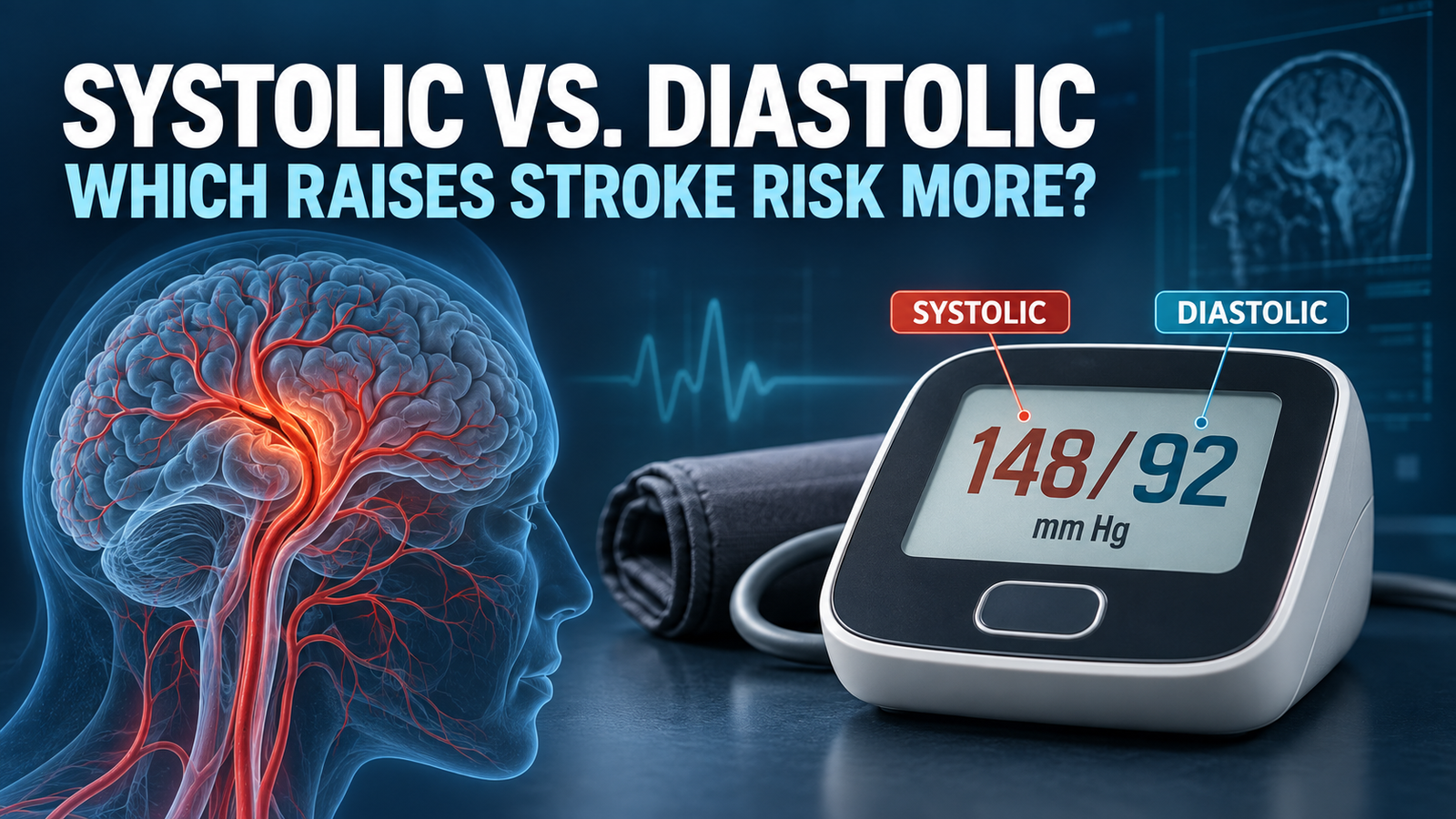
Use a sophisticated deep-navy, teal, white and controlled red-orange palette. Place a realistic upper-arm blood pressure monitor at center-right showing an illustrative reading of 148/92 mm Hg, with SYSTOLIC and DIASTOLIC clearly distinguished by two clean, color-coded callouts.
On the left, show a tasteful semi-transparent medical illustration of the brain and cerebral blood vessels, with one subtly highlighted artery representing stroke risk—no gore or dramatic rupture. Add a thin pulse-wave line and minimal clinical data shapes in the background.
Place the large, crisp article title in the upper-left with excellent spacing and generous safe margins for cropping. Use realistic materials, soft studio lighting, sharp focus and a trustworthy modern medical-journal aesthetic.
Read more :Why Is Systolic Blood Pressure High but Diastolic Normal?